For most of the history of computing, one assumption has remained almost unquestioned:
Computation happens on Earth.
We build data centers on land. We connect them to enormous electrical grids. We cool them using air and water. We move data across terrestrial fiber networks, and when satellites collect information, we usually bring that information back down before performing serious computation.
But the scale of artificial intelligence is beginning to challenge that model.
Modern AI systems require extraordinary amounts of computation, electrical power, networking bandwidth, cooling infrastructure, and physical space. At the same time, spacecraft themselves are generating increasingly large amounts of data and becoming responsible for increasingly complex missions.
This raises an unusual but increasingly serious engineering question:
What if some of the world's future AI infrastructure did not live on Earth at all?
What if instead of sending every bit of satellite data back to Earth, we processed it where it was generated?
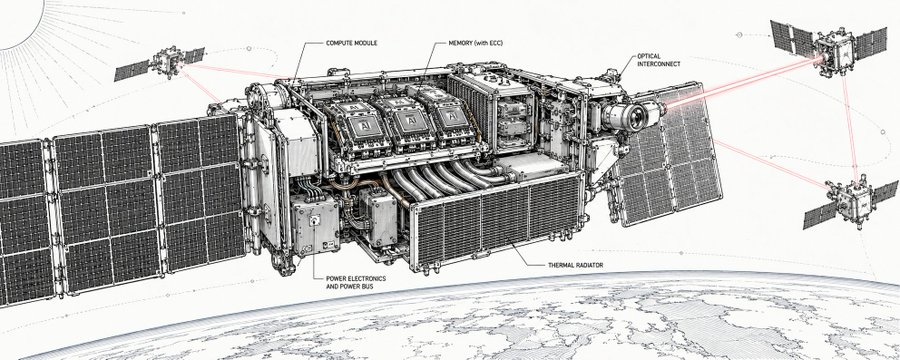
And what if, eventually, groups of satellites carrying specialized AI accelerators could cooperate with one another and function as something resembling a distributed data center in orbit?
This idea sounds futuristic.
But it is no longer purely theoretical.
Research programs such as Google's Project Suncatcher and MEE are investigating whether AI accelerators can operate reliably in orbit, whether large amounts of computational power can be supplied from solar energy, whether satellites can exchange enormous volumes of data using optical links, and whether many spacecraft can maintain the extremely precise formation required for tightly coupled distributed computation.
A recent research paper describing this broader architecture proposes fleets of satellites equipped with solar arrays, high bandwidth free space optical links, and TPU class accelerators. The researchers explicitly frame the problem as designing a scalable machine learning computing infrastructure in space.
But before asking how such a system can be built, we need to understand why it might be worth building at all.
1. What Are We Actually Trying to Build?
There are really three different ideas hidden inside the phrase "AI in space."
They should not be confused.
Level 1 AI enabled satellites
The simplest level is putting an ML model directly onboard a satellite.
Instead of behaving as a passive sensor, the spacecraft can interpret what it sees.
For example, imagine an Earth observation satellite capturing thousands of images every orbit.
Traditionally, the workflow looks something like:
Capture image → store image → wait for ground contact → downlink → process on Earth → make decision
With onboard AI, we can instead perform:
Capture image → analyze onboard → determine value → store/transmit only useful information
The satellite becomes an edge computing platform.
This has already been demonstrated.
Onboard AI can perform things such as:
- cloud detection,
- image classification,
- anomaly detection,
- target detection,
The architectural shift is important because the spacecraft stops being merely a sensor and starts becoming an intelligent participant in the mission.
Our existing satellite AI work describes this transition as moving from spacecraft that primarily collect, store, and relay information toward systems that can interpret observations, allocate resources, prioritize communications, detect anomalies, and make bounded decisions onboard.
2. Level 2, Autonomous Spacecraft
The next stage goes significantly further.
The AI does not merely process payload data.
It begins assisting with spacecraft operation itself.
Imagine a satellite capable of detecting:
"Reaction wheel number three is behaving abnormally."
Instead of waiting for operators on Earth, the spacecraft could determine:
"The vibration signature suggests bearing degradation."
It could then evaluate available alternatives:
"Reduce wheel speed, redistribute momentum to the remaining wheels, modify the observation schedule, and prepare for momentum dumping."
But the most important distinction is that the AI should not simply generate text describing these actions.
A real autonomous system must interact with spacecraft subsystems through tightly controlled interfaces.
The ML model becomes one component of a cyber physical control system.
And that distinction is extremely important.
For noncritical applications, such as determining whether an image contains clouds, an incorrect inference may mean losing an image.
For propulsion, attitude control, rendezvous, or collision avoidance, an incorrect inference could mean losing the spacecraft.
For that reason, a practical architecture normally allows AI to propose, estimate, rank or optimize decisions, while independently verified software decides whether those actions are actually safe to execute.
3. Level 3, Orbital AI Infrastructure
Now we arrive at the much more ambitious idea.
Instead of putting one AI accelerator inside one satellite, imagine putting many accelerators across many satellites.
Each spacecraft becomes something analogous to a compute node.
Together they form a distributed computing system.
At sufficient scale, the constellation begins to resemble a distributed data center. Instead of Ethernet or fiber connecting racks inside a building, spacecraft communicate using laser links.
Instead of a utility grid powering the servers, the constellation obtains power from large solar arrays.
Instead of cooling towers and fans removing waste heat, spacecraft use conduction, heat pipes and radiators.
Instead of racks remaining stationary on a data center floor, the compute nodes are moving around Earth at orbital velocity.
And every one of those differences introduces a serious engineering problem.
4. Why Would We Ever Do This?
The obvious question is:
Why spend enormous amounts of money launching computers into space when we can simply build more data centers on Earth?
There is no single answer.
Several trends begin to make the idea interesting.
4.1 AI's demand for energy continues to grow
AI infrastructure has become extremely energy intensive.
Training large foundation models requires enormous clusters of accelerators, while serving these models to billions of users produces a continuous inference workload.
Even though AI hardware and algorithms become more efficient over time, overall demand for computation can still increase faster than those efficiency improvements.
This creates a difficult infrastructure problem.
Future AI expansion requires increasing quantities of:
- electricity,
- cooling,
- land,
- grid connections,
- networking infrastructure,
- transformers,
- backup systems,
- water in some cooling configurations.
The question therefore becomes:
Where can future compute obtain extremely large quantities of energy?
One obvious answer is the Sun.
5. Space Has an Extraordinary Energy Source
Solar energy is not unique to space.
Solar farms obviously work on Earth.
But orbital solar generation has several interesting characteristics.
Certain orbital configurations can provide much longer periods of sunlight than terrestrial solar installations, where night, weather and atmospheric attenuation reduce energy availability.
The research underlying the space compute concept notes that solar panels in suitable orbits could receive substantially more solar energy annually than panels located at mid latitudes on Earth.
That changes the thought experiment.
Historically, space based solar power proposals imagined:
Instead of bringing the electricity to the computation,
bring the computation to the electricity.
That is one of the most compelling ideas behind orbital AI infrastructure.
6. The Satellite Data Problem
There is another reason to perform computation in space that is much more immediate.
Satellites are producing more data than they can efficiently transmit.
Modern Earth observation payloads can generate enormous quantities of imagery, radar measurements, hyperspectral observations and scientific data.
But spacecraft cannot continuously downlink everything they collect.
They are constrained by:
- contact time with ground stations,
- antenna capabilities,
- allocated spectrum,
- transmitter power,
- atmospheric conditions,
- ground network availability.
This means something strange happens.
A satellite may spend considerable energy collecting information that eventually turns out to be useless.
Consider an optical Earth observation satellite.
It photographs a region.
But 80% of that region is obscured by clouds.
A traditional architecture might still:
- capture the image,
- store it,
- schedule it for transmission,
- consume radio power,
- consume ground station capacity,
- transmit gigabytes of data,
- discover on Earth that the image is useless.
An onboard model can potentially determine this seconds after capture.
That is one reason edge AI in space is attractive independently of any orbital data center vision.
Your earlier research notes the same transition: moving computation onboard can dramatically reduce the amount of unnecessary data that must be transmitted to Earth and enable much faster local decision making.
7. Latency Changes Everything in Deep Space
For satellites close to Earth, communication delays can often be manageable.
For deep space missions, they fundamentally change how spacecraft must operate.
The farther a spacecraft moves from Earth, the less meaningful "remote control" becomes.
For Mars missions, communication delays can reach many minutes depending on planetary geometry.
Farther into the Solar System, delays become much longer.
At that point, autonomy is not just convenient.
It becomes necessary.
A spacecraft may need to independently perform:
- fault diagnosis,
- navigation,
- trajectory adjustment,
- scientific target selection,
- resource management,
- hazard avoidance,
- mission replanning.
Our prior work makes exactly this distinction: in deep space environments, onboard decision making moves from an optimization feature toward a mission requirement because closed loop ground intervention becomes impossible for fast critical events.
8. But Space Is Probably the Worst Place to Put a Computer
And this is where the idea becomes interesting.
Almost everything modern high performance computing depends upon becomes harder in space.
A terrestrial data center assumes that we can provide:
- abundant electricity,
- aggressive cooling,
- stable networking,
- technicians,
- replacement hardware,
- controlled temperature,
- physical accessibility.
A spacecraft gives us almost none of these conveniences.
So putting powerful AI hardware into orbit means solving a collection of problems simultaneously.
And many of them are coupled.
9. Problem One: Heat
This is perhaps the most counterintuitive problem.
People often think:
"Space is extremely cold, so cooling computers should be easy."
Unfortunately, that is not how heat transfer works.
Temperature and the ability to reject heat are different things.
On Earth, computers can remove heat using convection.
A fan pushes air across a hot component.
The air absorbs heat and carries it away.
CPU → heatsink → moving air → environment
But space is a vacuum.
There is essentially no surrounding air.
Therefore:
there is no convective cooling.
Fans become useless for rejecting heat to the environment.
Inside the spacecraft we can conduct heat through materials, but eventually that thermal energy must leave the spacecraft through electromagnetic radiation.
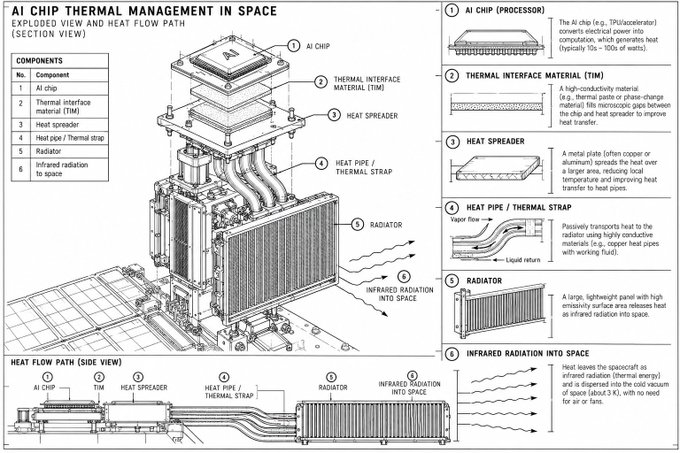
This changes the entire design philosophy.
A modern AI accelerator may consume tens or hundreds of watts.
Nearly all of that electrical power eventually becomes heat.
If a processor uses:
P=100W
for ten minutes:
E = P × t = 100 W × 600 s = 60,000 J
That is 60 kJ of thermal energy that the spacecraft must somehow transport, buffer or reject.
And the AI accelerator is not the only source of heat.
The spacecraft may simultaneously be receiving energy from:
- direct sunlight,
- Earth infrared radiation,
- reflected sunlight,
- batteries,
- radio transmitters,
- power electronics,
- payload instruments.
Thermal management therefore becomes a first class computing constraint.
10. Problem Two: Radiation
Terrestrial computers enjoy considerable protection from Earth's atmosphere and magnetosphere.
Spacecraft do not.
Electronics in orbit encounter:
- solar energetic particles,
- trapped radiation,
- galactic cosmic rays.
These effects can gradually damage electronics through accumulated radiation exposure.
But they can also create instantaneous failures.
One particularly important event is the Single Event Upset, or SEU.
A high energy particle can pass through a semiconductor and deposit enough charge to alter the state of a memory cell.
In simple terms:
0 → 1
or
1 → 0
A single bit changes.
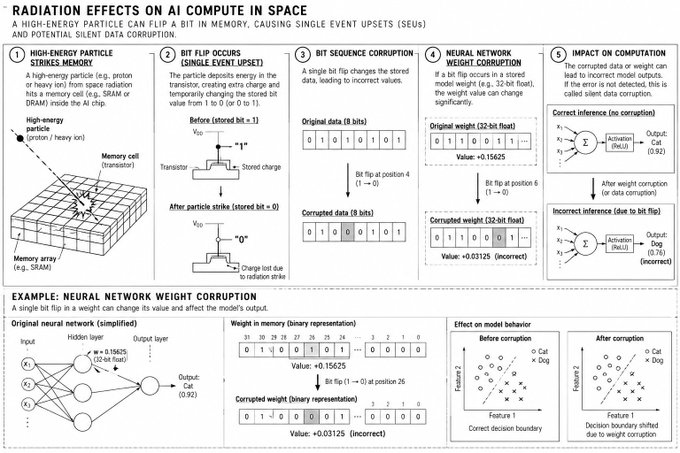
That sounds insignificant.
Inside an AI model, it may not be.
Suppose a bit belongs to:
- a neural network weight,
- an activation tensor,
- an instruction,
- an address,
- a DMA descriptor,
- a spacecraft decision state.
The effect may range from essentially nothing to catastrophic.
For example, if the flipped bit changes the exponent or sign of a floating point model parameter, its numerical value can change enormously.
The model may continue running normally.
No crash occurs.
But its answer is wrong.
This produces an especially dangerous phenomenon:
Silent Data Corruption.
The computer appears healthy while the intelligence running on it has become incorrect.
Your onboard AI report therefore treats radiation as more than simple processor survivability; faults can corrupt model weights, activation buffers, code, sensor frames, decision state, FPGA configuration or persistent model storage, requiring different protection strategies for each.
Project Suncatcher researchers have already subjected TPU hardware to radiation testing, and the associated study reports Trillium TPU exposure corresponding to a five year mission dose without permanent failure while also characterizing bit flip behavior.
But survival alone does not answer the harder question:
What happens to the AI model when faults occur while inference is running?
That question deserves an entire experimental campaign.
And that is something we will return to in Part II.
11. Problem Three: Power
On Earth, we normally design software assuming power is essentially always available.
A spacecraft cannot do that.
Every watt must be generated, stored, distributed and eventually dissipated as heat.
During sunlight:
Solar array ↓ Power regulation ↓ Spacecraft loads ↓ Battery charging
During eclipse:
Battery ↓ Flight computer Payload Communication ADCS AI accelerator Thermal control
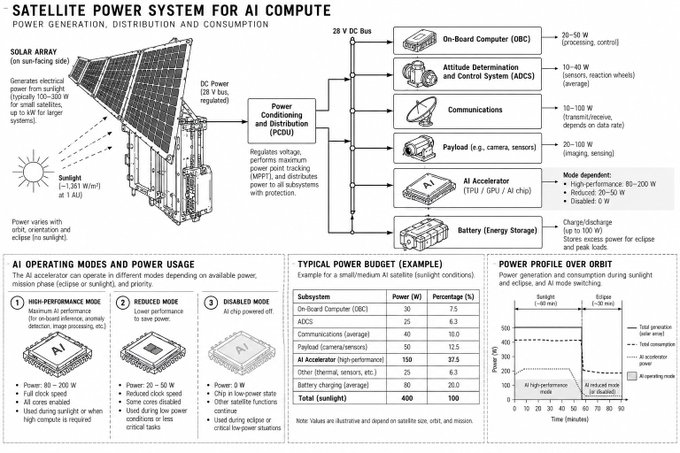
Every subsystem competes for the same energy reserve.
Therefore the question cannot simply be: "Can this processor run the model?"
The actual question is:
"Can this processor run the model while the payload, attitude control system, communications hardware and thermal control system continue operating, while preserving sufficient battery reserve for eclipse and contingencies?"
This leads to a completely different style of AI scheduling.
Inference itself may need to become energy aware.
The spacecraft might decide:
Battery 92% Thermal margin high Sunlight available → Allow high performance AI mode
Later:
Battery 37% Entering eclipse Payload active → Reduce accelerator frequency → Disable noncritical models
And under emergency conditions:
Battery critical → Disable AI accelerator → Switch to deterministic survival controller
Compute becomes another spacecraft resource.
12. Problem Four: Mass
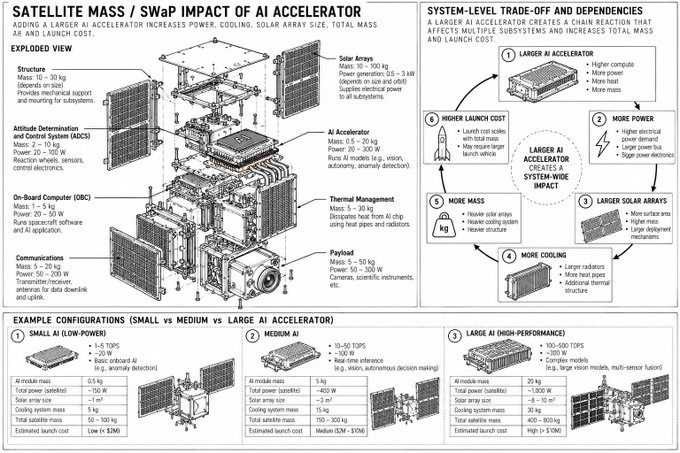
Every kilogram launched into orbit costs money.
And high performance computers require much more than silicon.
You also need:
- circuit boards,
- memory,
- voltage regulators,
- radiation protection,
- shielding,
- structural support,
- thermal spreaders,
- heat pipes,
- radiators,
- wiring,
- optical networking equipment,
- solar panels.
So the important metric is not necessarily:
TOPS
It becomes something closer to:
Useful operations / (watt · kg)
Because increasing compute may simultaneously increase:
- power,
- mass,
- radiator area,
- battery capacity,
- solar panel area,
- launch cost.
Space AI therefore becomes an extreme co design problem.
The neural network cannot be designed independently of the spacecraft.
13. Problem Five: Networking
A single accelerator can run relatively small models.
Large contemporary AI workloads frequently involve thousands of accelerators communicating with one another.
Inside terrestrial AI clusters, extremely fast interconnects move tensor data continuously between chips.
Replicating that architecture in space is extraordinarily difficult.
Traditional satellite links were generally not designed for this style of communication.
An orbital AI cluster could require communication rates orders of magnitude higher.
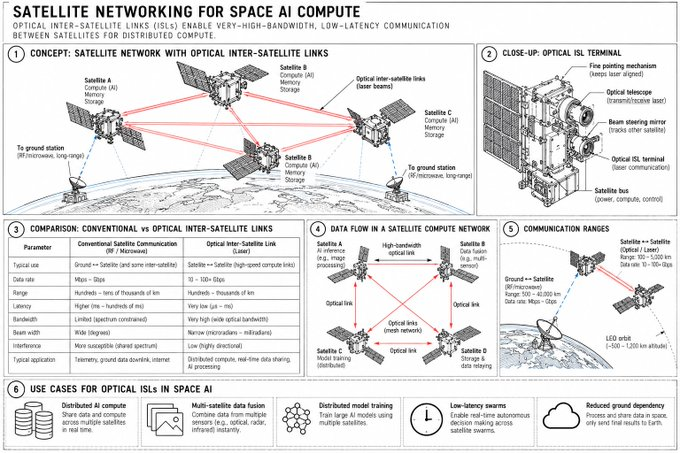
The proposed architecture therefore uses free space optical communication.
Essentially:
lasers between satellites.
The associated research discusses terrestrial ML clusters requiring inter chip communication at hundreds of gigabits per second and explores aggregate space links approaching the multi terabit per second regime by using dense wavelength division multiplexing and tightly spaced spacecraft.
But that creates another requirement.
The satellites must know exactly where their neighbors are.
And maintain precise pointing while moving at orbital velocity.
14. Problem Six: Formation Flying
Imagine two computers in a data center.
They sit a few centimeters apart.
Now imagine replacing them with two spacecraft.
They are travelling at roughly several kilometers per second around Earth.
They must:
- maintain relative position,
- maintain optical alignment,
- compensate for disturbances,
- avoid colliding,
- preserve network topology,
- avoid orbital debris.
And now imagine doing it with:
10 satellites.
Then:
100 satellites.
Then potentially thousands.
The network topology becomes coupled to orbital mechanics.
That is something terrestrial distributed systems engineers almost never have to consider.
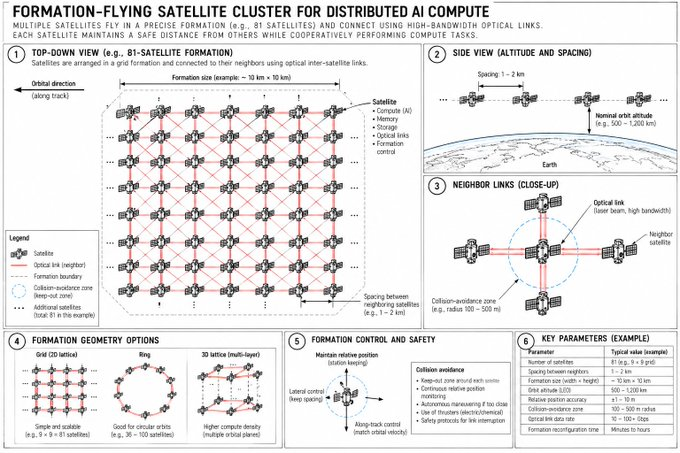
The physical location of the compute node becomes part of the network protocol.
Project Suncatcher's associated system study illustrates this with an example 81 satellite cluster and discusses using highly precise, potentially ML enhanced models for formation control.
At that point the distinction between:
distributed systems engineering
and
orbital mechanics
starts disappearing.
15. Problem Seven: Hardware Cannot Be Repaired Easily
If a GPU fails inside a terrestrial data center, someone replaces it.
If a satellite's AI accelerator fails:
there is no technician walking into the server room.
There may be no practical physical intervention at all.
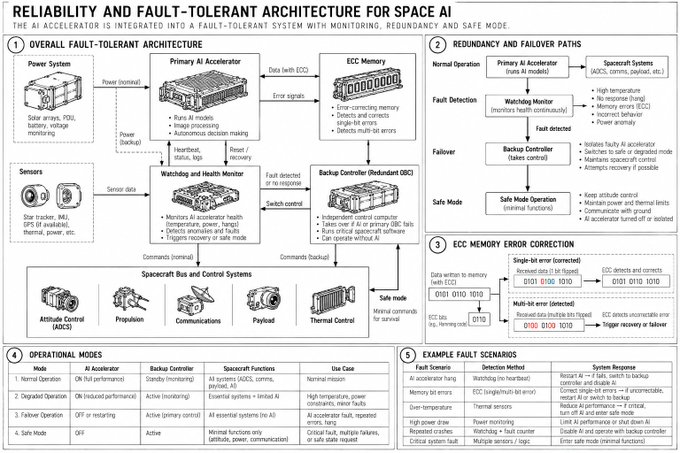
Space computing must therefore assume failures will happen.
That leads to architectures involving:
- redundant processors,
- watchdog timers,
- ECC memory,
- memory scrubbing,
- redundant model copies,
- health monitoring,
- rollback firmware,
- safe modes,
- fault detection isolation and recovery,
- graceful degradation.
16. Problem Eight: AI Itself Can Fail
There is one more problem that has nothing uniquely to do with spacecraft hardware.
Machine learning systems themselves are imperfect.
They encounter:
- distribution shift,
- unfamiliar inputs,
- sensor corruption,
- adversarial conditions,
- calibration errors,
- false confidence.
This becomes particularly dangerous when the AI controls a physical spacecraft.
Suppose the system sees an unfamiliar telemetry pattern.
A badly designed system might confidently declare:
"Reaction wheel failure."
and execute a recovery procedure.
But perhaps the measurement was simply corrupted by radiation.
A robust system should instead be capable of saying:
"The current observation is outside my validated operating distribution. Confidence is insufficient. I will not execute the proposed action."
This concept is called abstention.
And for autonomous spacecraft, knowing when not to act may be just as important as choosing the correct action.
Why This Could Matter
If these problems can eventually be solved, the implications extend far beyond simply putting GPUs in orbit.
Autonomous Earth Observation
Satellites could detect:
- wildfires,
- floods,
- illegal deforestation,
- oil spills,
- military activity,
- crop stress,
- infrastructure damage,
and communicate important observations immediately rather than transmitting enormous raw datasets first.
Autonomous Science
Space telescopes and planetary missions could decide which observations deserve attention without waiting for Earth.
A spacecraft could detect an unusual geological structure or atmospheric event and autonomously schedule additional measurements.
Deep Space Exploration
Future probes could diagnose failures and reconfigure themselves without waiting hours for commands from Earth.
Distributed Space Computing
Multiple spacecraft could cooperate on workloads that exceed the capability of any single vehicle.
Orbital AI Infrastructure
And eventually, if power generation, thermal control, networking, reliability and launch economics converge favourably, we arrive at the most ambitious possibility:
Solar energy ↓ Orbital compute constellation ↓ Massive distributed AI infrastructure ↓ Earth + space applications
Rather than building every future data center on Earth, humanity could begin expanding computing infrastructure beyond Earth.
The Interesting Part Is That None of This Is One Problem
That may be the most important conclusion.
There is no single breakthrough that suddenly gives us orbital AI.
The challenge is simultaneously:
an AI problem,
because the models must be efficient and robust.
A semiconductor problem,
because electronics must survive radiation.
A thermal problem,
because hundreds of watts of heat cannot simply be blown away with fans.
A power problem,
because every computation consumes scarce spacecraft energy.
A networking problem,
because distributed ML requires extraordinary communication bandwidth.
A controls problem,
because the compute nodes themselves are spacecraft flying in formation.
A reliability problem,
because hardware cannot easily be repaired.
A spacecraft engineering problem,
because mass, geometry, vibration and launch qualification constrain everything.
And ultimately:
a systems engineering problem.
Each subsystem affects every other subsystem.
More compute means more power.
More power means more solar array area.
More compute also means more heat.
More heat means larger radiators.
Larger radiators mean more mass.
More mass increases launch cost.
Greater compute distribution requires faster networking.
Faster optical networking requires tighter formation control.
Tighter formations increase collision risk.
And suddenly an AI architecture decision changes the orbital architecture of the spacecraft.
That is what makes this problem so fascinating.
20. So, Can We Actually Build It?
Probably not by taking today's data center and simply moving it into orbit.
The architecture will need to be redesigned around the physics of space.
Models will have to become smaller.
Precision may have to decrease.
Hardware will need to tolerate faults.
AI workloads may need to run intermittently rather than continuously.
Computation will need to react to power and temperature.
Neural networks will need safety boundaries.
Satellites will need sophisticated autonomous coordination.
And every design assumption will need to be tested against the environment it will actually experience.
The question therefore isn't simply:
Can an AI chip survive in space?
The much more interesting question is:
Can we design an entire computing system whose algorithms, hardware, thermal architecture, power system, networking, autonomy and spacecraft dynamics are all designed around one another?
That is the engineering challenge.
And that is where the experiments begin.
The next part will explain how we can actually solve this.